
Inspectez automatiquement les composants critiques des aiguillages et évaluez l’état des traverses — le tout à des vitesses pouvant atteindre 120 km/h.
L’imagerie 2D et le balayage 3D simultanés remplacent plusieurs systèmes traditionnels en un seul passage.
Des scans de 1 mm × 1 mm × 0,1 mm offrent une clarté inégalée des rails, traverses, attaches et du ballast.
L’analyse alimentée par l’IA garantit des résultats cohérents et objectifs d’un passage à l’autre.
Validée sur le terrain et approuvée par des exploitants ferroviaires à travers le monde.
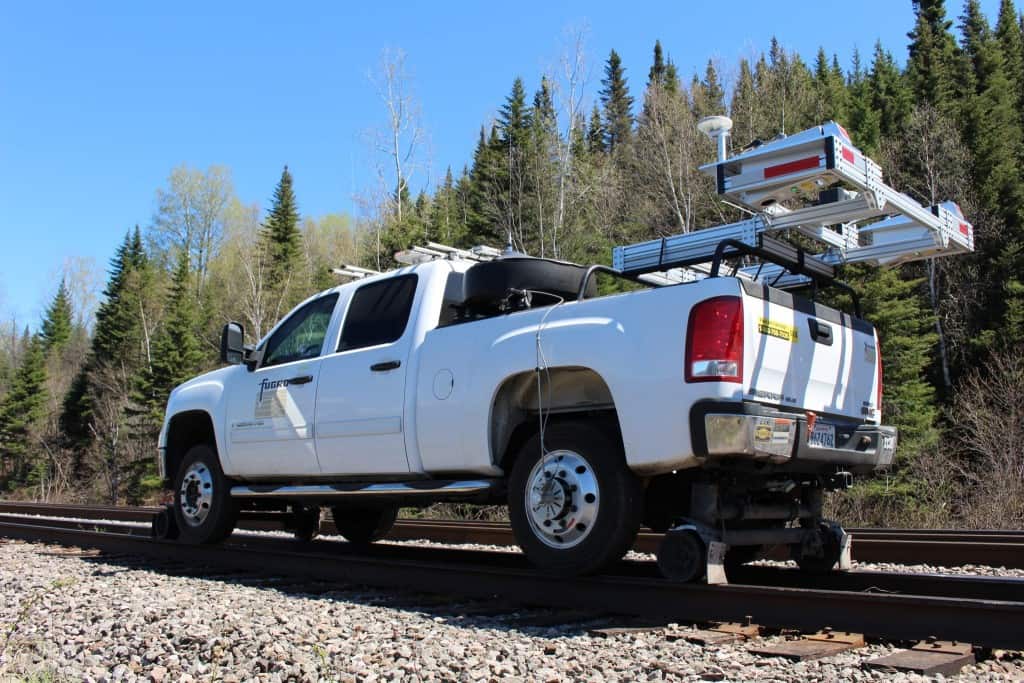
Le Laser Rail Inspection System Pavemetrics® (LRAIL™) est un système de vision 3D de nouvelle génération qui transforme l’inspection ferroviaire. En un seul passage, à des vitesses pouvant atteindre 120 km/h, le LRAIL capture à la fois des images 2D haute résolution et des profils 3D des rails, traverses et du ballast — offrant une clarté et une répétabilité inégalées.
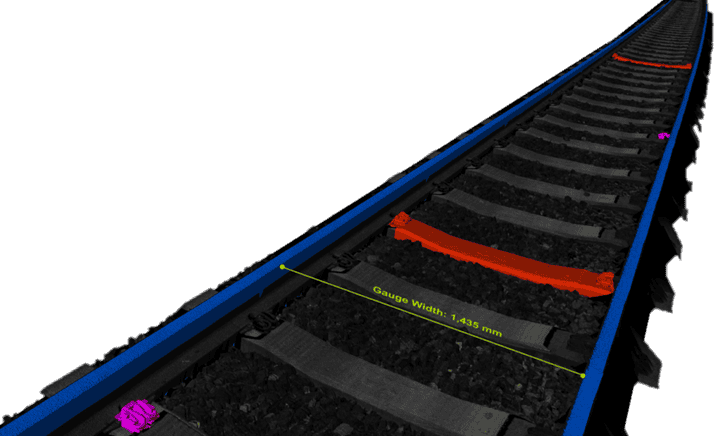
Propulsé par une intelligence artificielle avancée, le LRAIL détecte, mesure et évalue automatiquement tous les composants critiques, notamment les traverses, attaches, joints, aiguillages, cœurs de croisement et l’usure de surface du rail. Le résultat : une inspection complète et objective qui permet aux exploitants ferroviaires de hiérarchiser la maintenance, prolonger la durée de vie des actifs et réduire les coûts — sans perturber les opérations.
Basé sur la technologie éprouvée LCMS® de Pavemetrics, déployée dans plus de 50 pays, le LRAIL offre une précision validée sur le terrain, reconnue par les exploitants et autorités ferroviaires du monde entier pour des réseaux plus sûrs et plus efficaces.
fonctionne à des vitesses allant jusqu’à 120 km/h, entièrement automatisée et sans interruption des opérations.
s’adapte aux voies étroites, standard et larges.
capture simultanément des images 2D haute résolution et des nuages de points 3D en un seul passage.
détection automatique des changements et évaluation des traverses, attaches, joints, aiguillages et cœurs de croisement.
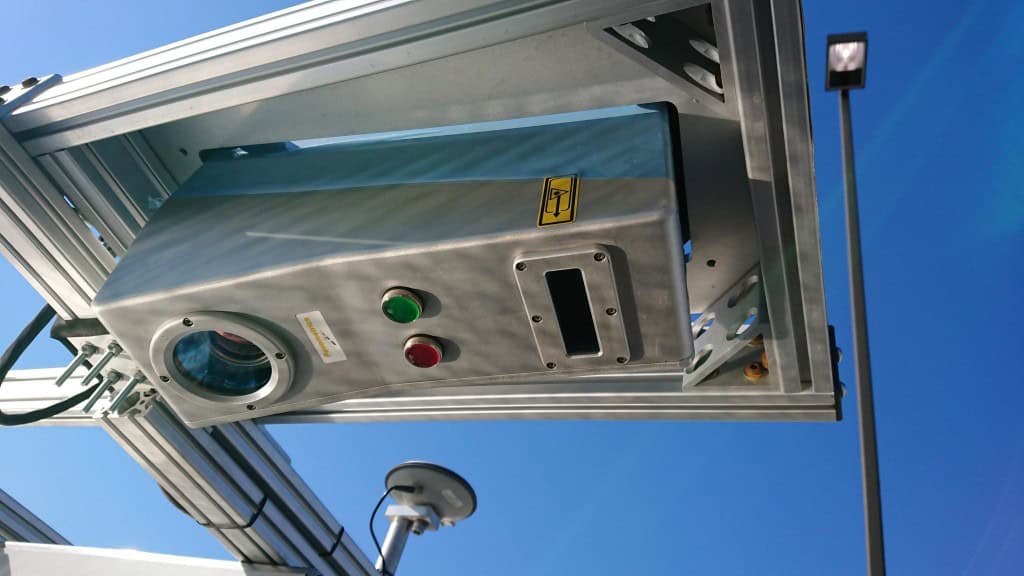
fonctionne de jour comme de nuit, insensible aux conditions d’éclairage ou d’ombre, avec des capteurs compacts de 13 kg intégrés dans des boîtiers robustes et scellés.
inspection des ancres, niveau et encrassement du ballast, attaches élastiques, géométrie du rail, profil et usure du champignon, traversées de route, composants d’aiguillage, état des traverses, plaques d’appui et tire-fonds.
Découvrez toutes les capacités de mesure et plus de détails: Voir les capacités de mesure
1 mm transverse, 0,1 mm vertical.
±0,25 mm vertical.
0–120 km/h (fonctionnement à vitesse de voie).
16 666 Hz.
Écartement étroit, standard et large.
Images 2D haute résolution et nuages de points 3D, géoréférencés avec GPS/IMU.
Capteurs compacts (13 kg chacun), faible consommation d’énergie.
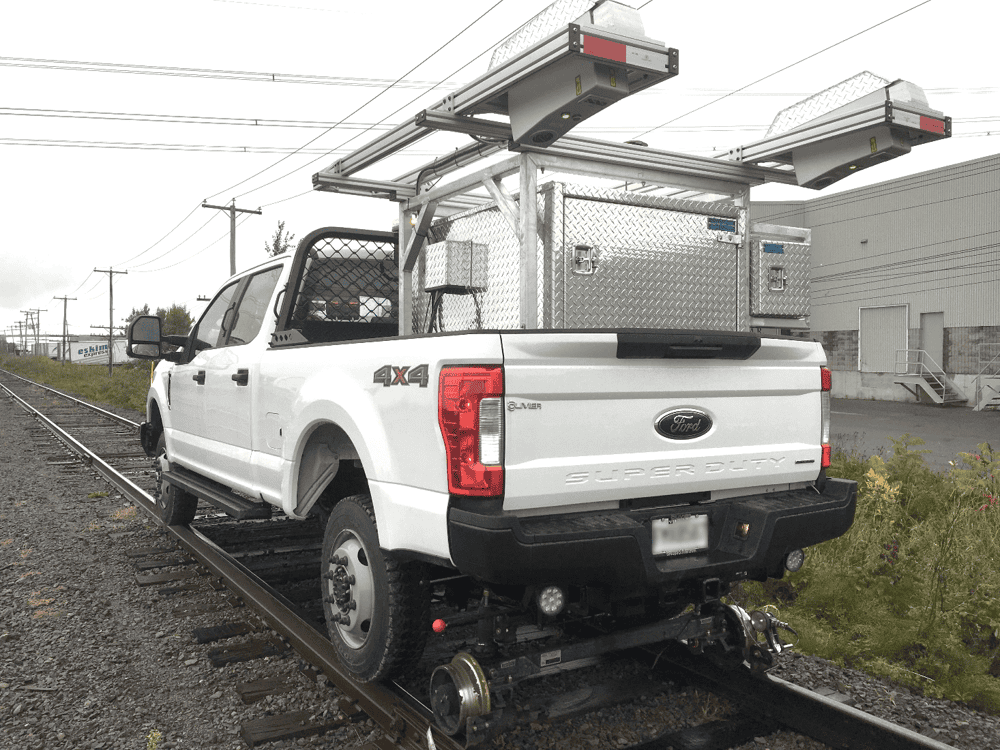
Compatible avec véhicules à rail haut ou wagons d’inspection dédiés.
Jour et nuit, insensible aux conditions d’éclairage et d’ombre.
Les algorithmes de compression embarqués minimisent les besoins de stockage.
En raison de la conception des TGMT et MOD, les exigences de la norme EN 13848-1:2003+A1:2008 doivent être adaptées. Par conséquent, cette annexe présente sous forme de tableau les exigences minimales pour chaque paramètre de géométrie de voie pouvant être mesuré par les TGMT et MOD. Les exigences différant de la norme EN 13848-1:2003+A1:2008 sont mises en évidence en gras. Les exigences de la norme EN 13848-1:2003+A1:2008 sont indiquées uniquement à titre comparatif.
Summary: In this project led by the US Department of and University of Massachusetts Lowell, the use of commercial remote sensing and spatial information technologies such as Ground Penetrating Radar, laser (LRAIL), GIS and GPS have been applied to passenger rail inspection. The technologies were integrated on a hi-rail vehicle and tested at the Massachusetts Bay Transportation Authority (MBTA) and Metro St. Louis. While rail transit agencies in the United States rely heavily on visual observation for their weekly track inspections, this manual method is time-consuming, costly and cannot effectively identify subsurface safety hazard. The main objective of this project was to provide a safe, objective and cost-effective solution to rail transit agencies for their weekly track inspections. The conclusions of this project highlight the quality of the collected data and the results generated by the developed algorithms of the LRAIL and suggested that it is a viable and very promising solution to use for track safety inspections.
Abstract: This report documents the successful use of 3D laser scanning, Deep Convolutional Neural Networks (DCNNs), and change detection technology to reliably detect and classify a wide variety of track components and conditions that influence the safety of train operations, and to report changes in these features over time with high precision. This technology advances the state-of-the-art in automated track inspection, going beyond the simple pass/fail assessments typical of current inspection approaches. During the test program, conducted between April 2019 and October 2020, it detected a wide range of both small and large changes related to elastic fasteners, spikes, joint bar gaps, joint bar bolting, crosstie skew, ballast level, and ballast fouling.
Abstract: This paper builds on prior work (Deep Learning for Railroad Inspection – Phase 1) to develop a Deep Neural Network that can automatically identify key railway components as a step in the process of automating rail inspection in an effort to overcome the limitations of traditional methods. This new study adds the identification of new railway components (Tie Plates) as well as the automated assessment of their condition.
Abstract: Railway networks around the world are an important part of the transportation network and represent billions of dollars of investment. Poorly maintained networks negatively impact asset longevity, schedule performance and pose a serious threat to safety. In order to safeguard against these risks, Railroads typically inspect 100% of their mainline network at least annually and key locations even more frequently. Railroad inspection has traditionally been a manual process with inspectors walking the track or driving slowly in a high-rail vehicle to visually spot problems. This practice is very costly, time consuming, impacts schedule performance (due to the need for track possession), and puts staff at risk. While there have been some recent attempts to modernize the inspection process through the adoption of machine-vision technologies, these technologies are often still reliant on human inspectors manually reviewing images in order to spot defects. Manual review of images suffers from many of the same problems as manual inspections do: it is time consuming, subjective as opposed to being objective, and requires significant amounts of labor. This paper will explore a new approach which makes use of Deep Learning algorithms, specifically a Deep Neural Network, to automatically inspect images and has the potential to overcome these limitations.
Abstract: This report documents the successful demonstration of automated change detection on railroad track. Pavemetrics Systems Inc. performed this research under contract with the Federal Railroad Administration between March and December 2017. The project successfully demonstrated the ability of its Laser Rail Inspection System (LRAIL) to detect changes in fasteners, anchors, spikes, ties, joints, and ballast—as well as record rail stamping information on Amtrak's Harrisburg line.
Abstract: This report details the deployment of Pavemetrics' Laser Rail Inspection System, "LRAIL," for the purposes of automated change detection. The project was conducted between September 2018 and December 2019 at filed locations on Amtrak property and at Pavemetrics' offices in Quebec, Canada. The project involved a combination of field sensor data acquisition, deliberate manual changes in the field, office algorithm development, algorithm testing and validation, and system performance reporting. The extended field trial proved successful. Repeatability, mean, and standard deviation of change measurements were determined and noise floors for each measured parameter were established.
Explore Eddyfi Technologies product lines
 Automated Vision Systems
 ET & UT Solutions
 Nuclear Steam Generators
 Remote Monitoring Solutions



 Robotics Solutions